



 October 19th, 2026
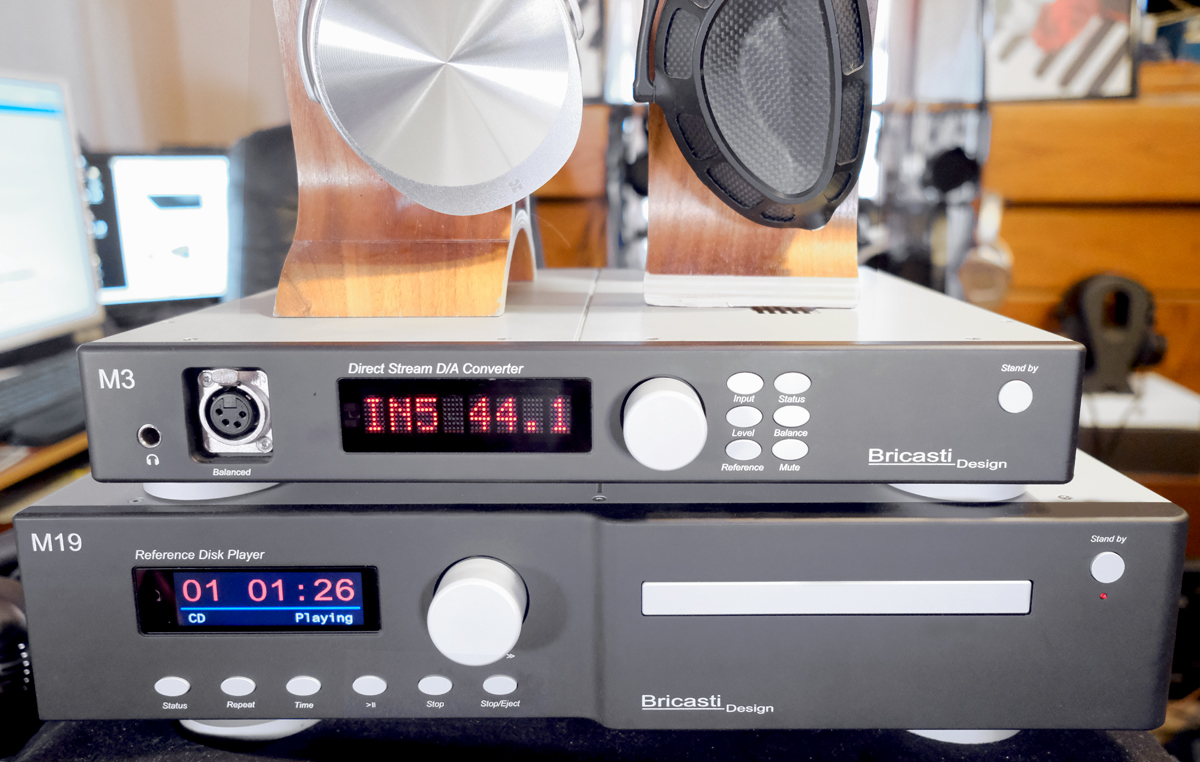
The Bricasti M3 Digital to Analog Converter (which my brain always interprets as Biscotti) has long been a popular fixture at CanJams as DAC of choice among many high-end headphone manufacturers, and one that sparked my interest, but I never had a Bricasti connection from which to procure a review sample. At CanJam SoCal 2026, when he heard that I was reviewing the Saros Audio Systems Europa Fully Differential Tube Headphone Amplifier, my friend Makiah from HeadAmp asked if he could send me the Bricasti M3 Digital to Analog Converter and Bricasti M19 Reference SACD/CD Transport to see how they worked with the Europa. Unfortunately, the review was almost done by the time the Bricasti units arrived, so they weren’t able to be included in that review; hence this review.
The Bricasti M3 Digital to Analog Converter
Highlights for the Bricasti M3 Digital to Analog Converter include two fully differential conversion channels, separate conversion for PCM and native DSD, and a balanced analog level control circuit, incorporating the latest Bricasti Design high-performance MDx processor. Furthermore, the M3 utilizes two independent linear power supplies for the analog and digital processing to ensure low noise and superior isolation. A newly designed chassis made from robust aluminum CNC-milled in sections is employed to achieve superior thermal characteristics, excellent vibrational damping, and shielding from RF.
Digital design of the M3 uses precision DDS clocking that lowers jitter to extremely low levels, ensuring a pure digital signal path without the use of sample rate converters; this is combined with superior digital filter design and Native DSD conversion to yield a state-of-the-art digital audio path. A bypassable preamp class analog level control is provided to drive power amps directly for optimal analog performance. This is coupled to independent analog amplifiers for both plus and minus on the XLR output to create a fully balanced headphone system.
An I2S Card is available for use with the Bricasti M19 Reference SACD/CD Transport, or an internal network player option is available that works with any app that is DLNA and UPnP compatible. The M3 is now Roon Ready.
To quote Bricasti, “All of our products are crafted in the old world tradition, in a classic brick mill building in Massachusetts, USA by a team of individuals dedicated to excellence.”
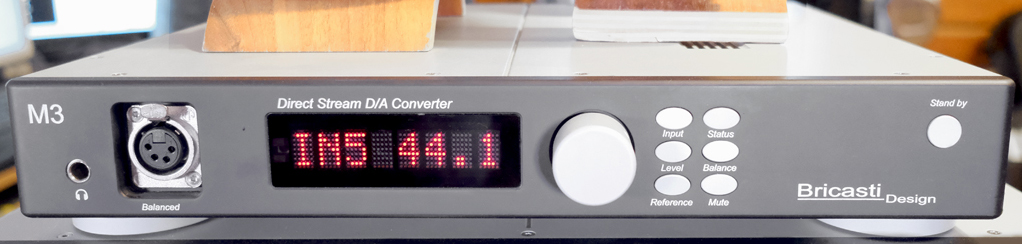
In appearance, the M3 has a sleek industrial design with black front, side, and rear plates, and bare aluminum top and bottom with large isolation feet. On the front panel you will find a single-ended ¼” TRS headphone connector, a 4-pin Balanced headphone connector, a large LED display, an Aluminum finish Control Knob, 6 front panel keys (from left to right: input, status, level, balance, reference, and mute), and a “Standby” button.
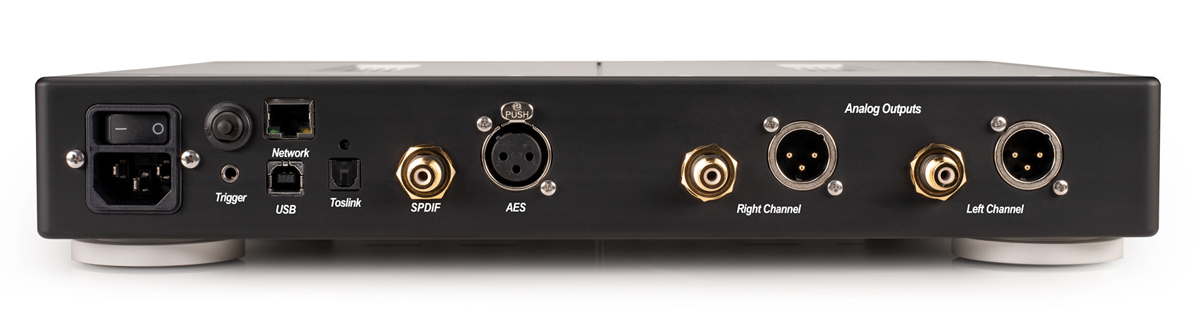
The inputs are: “IN1 AES” (XLR), “ IN2 SPDIF” (RCA SPDIF), “IN3 EIAJ” ( Toslink), “IN4 USB”, and “IN5 LAN” is for the optional network streamer, or, as in this case, the I2S Card. The inputs can be renamed via a list of common names.
The Status button selects between 10 different functions:
- Input: Displays input and sample rate
- PCM playback oversampling filter: Two different Linear and two different Minimum PCM filters are selectable in this mode. This filter only affects PCM playback and not DSD.
- Temp Monitor: Displays the internal temperature at the center of the unit on the digital processor.
- Version: The current software version.
- Display Intensity: Set to 3 levels, sleep, or off. Selecting OFF will shut the display off after a 20-second timeout, leaving one LED dimly lit. Pressing any front panel key will wake up the display.
- Clock Setting: Fine for high-performance clock sources, Wide for less accurate clock sources.
- Trigger functions: Sets the M3 trigger commands. CtlTRIGO sets trigger out, CtlTRIGI for trigger in, CtlREMOTE for extensive exclusive control by another device ( disables the M3 remote).
- Phase Invert: This is handled in the digital domain, so no inversion of DSD is possible.
- DSD conversion mode: NDSD DSD is for using our pure 1 bit analog conversion, and NDSD PCM is for using the ADI 1955 sigma-delta converter path.
- Remote standby mode: This will allow use of the balance key on the remote to be used as a standby key to remotely place the M3 in standby. Normal operation is RbalNORM; alternate mode is RbalSTBY.
The Level button is actually the mute button. The M3 has an analog level control, with a range in single dB increments of -90dB to +6dB with 0 being bypass mode
The Balance button allows adjustment of the analog balance control in .5 dB steps.
The Reference button is a user memory for a reference level setting.
The Mute button appears to have identical function to the Level
On the rear panel you will find the USB 2 type interface, and it is based on the latest generation of asynchronous design and supports sample rates up to 384k/24 bit PCM and DSD 256 as native format. For superior noise performance, the interface is electrically isolated from the host computer, eliminating any grounding or power-induced noise issues that could be transmitted to the M3 from the computer. Special drivers are necessary for Windows and can be downloaded from the Bricasti website.
The Bricasti M19 Reference SACD/CD Transport
One might ask why, in this day and age of music servers and streaming services why anyone would want a CD transport. But the truth is there is a large community of Red Book (standard CD) enthusiasts among the AES crowd, ignoring the physical drawbacks of mechanical media, exasperated by there being no standard for CDs as to weight and balance, and its susceptibility to external resonance; this is why high-end CD players are so expensive, error correction = a loss of resolution, and with the limited 44.1kHz sample rate of Red Book you are barely covering the audible bandwidth to begin with, much less the necessary phase and timing nuance necessary to create a proper soundstage. On the other hand, the Bricasti M19 Reference SACD/CD Transport also supports SACD, and sadly, there is a large catalog of SACDs that have never been released as DSD (the basic recording format of SACD), and on top of that, SACD transports (as opposed to full SACD players) are extremely rare due to restrictions put in place by Sony, though I will note that Bricasti does not offer a multi-channel option to take full advantage of the format.
One of the key features of the M19 is the power supply design, made by adopting two oversized independent linear power supplies with medical-grade toroidal transformers; one dedicated to power the drive’s transport mechanical aspects; the motor drive and loader, and the other for the digital aspects and those related to the audio path, keeping the two sections completely autonomous from one another and importantly to supply stable, high current power for the motor and mechanical aspects, ensuring accurate and stable motor speeds, and removing any potential cross-feed contamination between the drive and the rest of the audio path electronics reducing potential sources of jitter, and or power supply ripple.
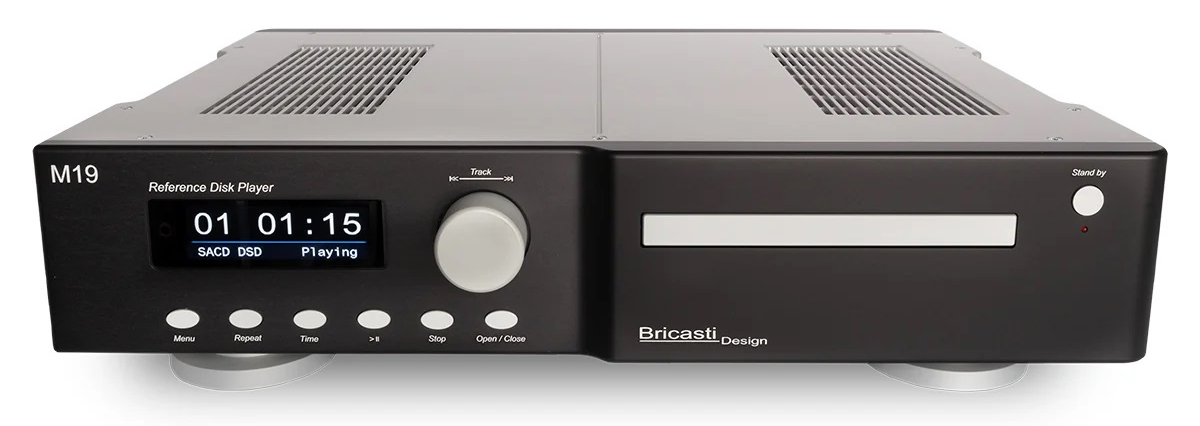
Like the M3, the M19 is crafted as one complete assembly in a milled aluminum chassis, with the benefit of having its power supply in close proximity to the drive and digital output sections, significantly reducing the possibility for RF contamination, and ensuring excellent isolated current delivery from the supply to the drive motor. Though the footprint of the M19 is 17” as opposed to the 14” of the M3.
The M19 offers a proprietary I2S digital output to be exclusively used with Bricasti DACs.
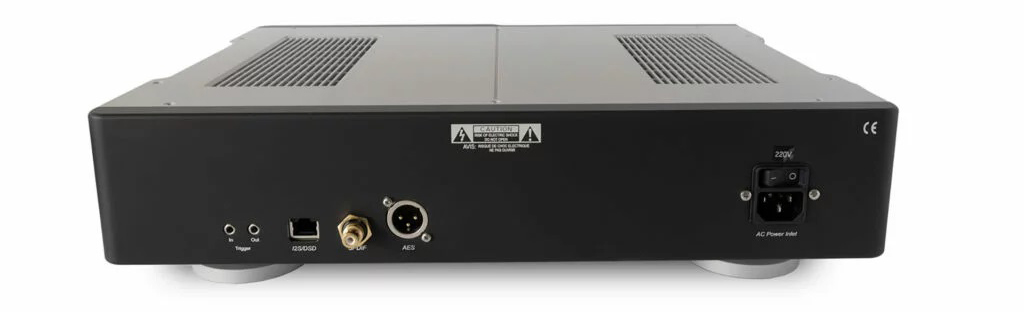
Living with the Bricasti M3 Digital to Analog Converter & Bricasti M19 Reference SACD/CD Transport
I set up the Bricasti M3 Digital to Analog Converter & Bricasti M19 Reference SACD/CD Transport with the M3 on top of the much larger M19, connected together with a provided Bronze Dragon Ethernet Cable, and fleshed out with a Black Dragon USB Cable, and connecting to the above-mentioned Saros Audio Systems Europa Fully Differential Tube Headphone Amplifier via the balanced 3-pin XLR outputs using Black Dragon Power Cables, and a Core Power Technologies A/V Equi=Core 1000.
For headphone once again I picked my two top reference headphones: the Dan Clark Audio STEALTH with a Moon Audio provided 10’ 4.4mm TRRRS Bronze Dragon Cable, and the HIFIMAN SUSVARA UNVEILED likewise with a 10’ 4-pin XLR Bronze Dragon Cable.
As is my wont, I began my listening tests with new releases from Qobuz, in this case a High-Resolution 24-bit/96kHz release of Genesis’ first album “From Genesis To Revelation (2026 Mix)”. This is an old favorite despite being more of a Psychedelic bend than the signature Progressive Rock of their later releases. I was immediately impressed with a musicality that I had not previously heard even on vinyl, one presumes a product of the remix. The piano for “A Place to Call My Own” had a rich tone and massive soundstage, especially for the choral and mellotron outro, and Peter Gabriel’s multiple voices were captured in their full intensity across all the tracks. The extreme dynamics of almost every track building to a crescendo was displayed with musicality and excellent delineation.

My next choice was an album I have been meaning to listen to for a while now, “Landfall” (24-bit/44.1kHz – Qobuz) by Laurie Anderson and the Kronos Quartet. Again, the soundstage and dynamic range were massive, as was the musicality. Inspired by Laurie Anderson’s experiences during Hurricane Sandy, the pieces are savage and brutal with the intermingling of the five string instruments (three violins including Laurie, viola and cello) supplemented by Laurie’s keyboard work and percussion, and of course vocals. The sound was eerie, ethereal, and magical.

Ironically, even though I own two SACD players, I only have a single SACD, so I turned to my DSD library to simulate the experience. Bringing up a track I don’t use anymore because it appears to be DAC-unfriendly, often producing undesirable background noise, I put on Eiji Oue and the Minnesota Orchestra’s Reference Recordings performance of “The Firebird Suite” (DSD). While I prefer Robert Shaw’s version, this is a masterful performance and, by its nature, a better recording. Luckily, I experienced none of the issues that made me put the recording aside. As above, the dynamics fully encompassed the slam of the tympani, and the vast airy atmosphere of the great hall was completely realized in the soundstage. The individuality of the musicians and their instrument was lovingly replicated in fine detail with marvelous timbre and tonal balance.

Time had arrived to use the M19, while I truly believe the real purpose of the M19 is to play SACD, Red Book is still the most challenging for both player and DAC. When I was setting up the M19, the first disc to come to hand was Regina Spektor’s “Songs”, so it was the disc that was in the machine when I started the evaluations; hence it is the first I listened to. The cold studio gave the piano the air and tone of schoolroom piano, I don’t know why but that is what I heard. Regina’s voice was unhampered by equalization or artificial reverb.

One of my touchstone recordings is “Foxtrot” by Genesis, which I have been using as a reference piece for over 50 years in my different roles in the audio industry. “Can-utility And The Coastliners” tells me more about tonality, bandwidth, resolution, and dynamic range than any other single track. I could hear the subtle decay of Michael Rutherford bass pedals, as well as the attack and decay of pick against string on the bass guitar. There was a crispness to the guitars and percussion that made the experience all that more real.

Unlike the primitive Regina Spektor recording, the eponymous track from Supertramp’s epic “Crime of the Century” gave the impression of a piano and vocalist in a massive empty space; in fact, only the bass and percussion had a sense of proximity.
As a final indulgence, I put on an old favorite that was only released digitally a few years ago, Neil Merryweather’s “Space Rangers” and the classic “Hollywood Blvd”, the energy, the soundstage, the amazing transient response, Heaven.
As an afterthought, I realized I had not listened to the M3 as a headphone amp, so I warmed it back up and plugged in the SUSVARA UNVEILED via the 4-pin XLR output and put on “Big Yellow Taxi” (“Ladies Of The Canyon” – 24-bit/192kHz) by Joni Mitchell; this is where I discovered that you have to hit the “Level” button to engage the volume control. -20dB proved to be the max comfortable volume with the SUSVARA UNVEILED; in fact, I found myself lowering it to -23dB while evaluating. Excellent clarity and a neutral tonal balance appeared to be the watchwords.
I had to turn the volume up a bit for DSD when listening to “Birds Of Fire” (“Birds Of Fire” – Mahavishnu Orchestra – DSD), which means that there is no gain compensation for the different format. While the resolution was wonderful, the soundstage and sub-bass extension were not equal to the performance with the Europa.

As a final test, I switched back to the STEALTH and put on my one SACD “Regeneration” by Stephen Lyman for a first-time listening. This turned out to be a recording of solo nylon six-string acoustic guitar. This gave a fairly intimate soundstage in a large room. As above, the tonal balance and timbre of the guitar appeared spot on, with excellent micro-detail.
Conclusion on the Bricasti M3 Digital to Analog Converter & Bricasti M19 Reference SACD/CD Transport
The Saros Audio Systems Europa Fully Differential Tube Headphone Amplifier is indeed an excellent match for the dCS Bartók APEX DAC with Headphone Amplifier, but at $24,100 the Bartók is not necessarily the best choice for the Europa, I mean, if you can afford it, go for it, but there are DACs more in keeping with the budget of the Europa, and the Bricasti M3 Digital to Analog Converter fits that bill perfectly and offers performance in keeping with the demands of a reference system.
As a DAC, the M3 competes with the very best I have heard. It is much more musical than the Chord DAVE, but not quite as analog as the Bartók, and more versatile than the Schiit Audio Yggdrasil Singular, being able to not only play DSD but to link with an SACD transport to play DSD tracks not available as purchasable files.
As a headphone amplifier, the M3 is acceptable, but clearly not the primary emphasis; it certainly has plenty of power, and the musicality is in keeping with the DAC itself, but a discerning listener will want to scale up for reference listening.
The surprise, that was not really a surprise, was the Bricasti M19 Reference SACD/CD Transport, I mean, I have heard quite a few transports in this price range; it is the preferred source among many audiophiles who are a bit resistant to change, but the pleasure that it was able to wring out of my old CDs was amazing. If you have a collection of SACDs and intend to purchase the M3, I heartily recommend the M19.
All in all, I find the Bricasti M3 Digital to Analog Converter & Bricasti M19 Reference SACD/CD Transport well worth the listen, and easily justify their not inconsiderable price tags.
Manufacturer’s Websites:
https://www.bricasti.com/en/consumer/m3.php
https://www.bricasti.com/en/consumer/m19.php
Price:
Bricasti M3 Digital to Analog Converter: $6,500
Bricasti M19 Reference SACD/CD Transport: $10,000
Specifications
Bricasti M3 Digital to Analog Converter
| Digital Inputs | XLR: AES/EBU 24 bit Single Wire, RCA: SPDIF, Optical: Toslink 44.1- 96k, USB 2, RJ45: Ethernet (Optional) |
| Sample Rates AES, SPDIF | 44.1 kHz, to, 192khz, DSD 64fs as DoP |
| Sample Rates USB | 44.1 kHz, to, 384kHz, DSD 64fs 128Fs 256Fs Native and DoP |
| Sample Rates Ethernet | 44.1 kHz, to, 384kHz, DSD 64fs, 128Fs Native |
| Jitter | 8 psec @ 48k / 6psec @ 96k |
| Balanced Analog Outputs | XLR balanced (pin 2 hot) |
| D/A Conversion | PCM 24 bit delta sigma 8x oversampling, NDSD pure 1 bit conversion for DSD |
| Impedance | 40 ohm |
| Output Level | @ 0 db front panel +14.3 dbm 4 db RMS ( bypass mode) |
| Frequency Response @44.1k | 10 hz- 20 kHz +0dB, -.2 dB |
| Dynamic Range | >120dB A-Weighted |
| THD+N @ 1k | .0008% @ 0dbfs / .0004% @-30dbfs |
| Unbalanced Analog Outputs | RCA |
| D/A Conversion | PCM 24 bit delta sigma 8x oversampling, NDSD pure 1 bit conversion for DSD |
| Impedance | 40 ohm |
| Output level | @ 0 db front panel = +4db 2V rms |
| Frequency Response @ 44.1k | 10 hz- 20 kHz -.2 dB |
| Dynamic Range | >120dB A-Weighted |
| THD+N @ 1k | .0008% @ 0dbfs / .0004% @-30dbfs |
| M3H Headphone Driver Option | 4 pin XLR balanced or TRS stereo |
| Output impedance: | < 500 ohm (20Hz-20kHz) |
| Max. Output <1% THD: | 8.8V or >100mW/600ohm |
| A-Weighted S/N: | 116.3db |
| THD: | 0.00025% |
| General Specifications | |
| Finish | Anodized Aluminum |
| Dimensions: | 14” x 11.25“ x 2.5” |
| Weight: | 10 lbs |
| Shipping Weight: | 15 lbs |
| Mains Voltage: | 100, 120, 220, 240 VAC, 50 Hz – 60 Hz factory set |
| Trigger in/out: | TRS mini jack, Tip ground, Sleeve 5V |
| Power consumption: | 20 Watts |
| Warranty parts and labor: | 2 years non-transferable |
Bricasti M19 Reference SACD/CD Transport
| Digital Outputs | XLR: AES/EBU 24 bit Single Wire, RCA or BNC, SPDIF, RJ45 Proprietary I2S |
| Sample Rates AES, SPDIF | 44.1 kHz, or DSD 64fs as DoP |
| Sample Rates I2S | 44.1 kHz, to, 384kHz, DSD 64fs, 128Fs Native |
| General Specifications | |
| Finish | Anodized Aluminum |
| Dimensions: | 17” x 12.5“ x 4.5” |
| Shipping Dimensions: | 22”x 17”x 7” |
| Weight: | 20 lbs |
| Shipping Weight: | 25 lbs |
| Mains Voltage: | 100, 120, 220, 240 VAC, 50 Hz – 60 Hz factory set |
| Trigger in/out: | TRS connector for 5V external trigger on ring. |
| Power consumption: | 20 Watts |
| Warranty parts and labor: | 2 years non-transferable |
Share This Entry


Leave a Reply
Want to join discussion?
Feel free to contribute!